
ANIMAL BIOGRAPHIES: LIMITS, POSSIBILITIES, AND POTENTIALS

How many biographies of Napoleon (1769–1821) have been written?[1] And in how many of these biographies is it explicitly stated, when describing the Battle of Waterloo (1815), that alongside 200,000 soldiers, more than 40,000 horses also lost their lives?[2] What about the 1.4 million horses[3] that died in the American Civil War (1861–1865), or the approximately 1 million that served in the First World War (1914–1918), half of which were lost at the front? Or the horses that were the ‘founders’ of the metropolises? In Britain alone, the number of horses used for transport at the beginning of the twentieth century reached 1.5 million.[4]
Most people are familiar with Spielberg’s Saving Private Ryan (1998). Set during the Second World War (1939–1945), the film follows the story of an ordinary soldier and strips war of grand narratives of heroism, inviting reflection through human fear, vulnerability, emotion, and ordinariness. But what does Spielberg’s War Horse (2011), adapted years later from English writer Michael Morpurgo’s biographical story (1982) set during the First World War, do?
Christian Pearson notes that, by excluding animals[5] from historiography for centuries, academic historians were late to recognize what Spielberg and literary writers had already recognized. Yet two developments that have gained prominence in recent years, the animal turn and the biographical turn, have sought both to fill these conventional gaps in historiography and to turn the gaps themselves into a problem of choice and regimes of seeing. Both orientations compel us to reconsider which subjects are placed at the center of history, which experiences are deemed narratable, and how what is considered “important” is determined. It is possible to define animal biography as a distinct writing practice that emerges precisely at the intersection of these two developments.
Interest in animals within academia is not new. However, in recent years, traditional historiographical practices in which animals have often been confined to symbolic or instrumental roles have increasingly come under scrutiny, and a marked qualitative shift has begun to emerge in the treatment of non-human animals as active participants in historical processes.[6] The animal turn, by challenging anthropocentric regimes of knowledge production, has made it possible to take animals seriously as historical and social actors.[7] This development has also destabilized established assumptions regarding the moral, legal, and political status of animals. The biographical turn, meanwhile, alongside critiques of histories narrated through “great men” and macro-structures, has re-established the epistemological value of individual life stories in the production of historical knowledge.[8] By breaking the hierarchical structure of historical narratives constructed “from the top down,” it has opened an alternative path extending “from the individual upward.”[9] The intersection of these two developments constitutes the theoretical and methodological foundation of animal biography. Above all, animal biography seeks to make visible the individuality, personality, agency, and unique mode of existence of each animal.[10] Yet this effort is not grounded in an attempt to “read” the inner worlds of animals from an anthropocentric perspective. Rather, it seeks to reconstruct the traces of their relationships with the world within their historical and cultural contexts and to reinterpret these contexts through a new perspective, from below upward.
This article examines different writing practices and the potentials they carry through two horse biographies from different periods and geographical contexts: Warrior (1908–1941), rewritten by Eric Baratay, and Polat (2019–2023), written by Asu Aksoy. While the first example represents a methodological intervention that places the animal’s subjective world at its center and keeps that center remarkably broad, the second produces biographical depth on a different plane by constructing the animal’s experience together with the political and social crises of its time. Through this comparison, the article aims to reflect on the possibilities, limitations, potentials, and ethico-political burdens of animal biography.
From a Narrative of Heroism to Releasing the Reins: Warrior
Warrior is one of the most celebrated war horses in Britain’s memory of the First World War (1914–1918). He served on the front throughout the First World War and, unlike most of his fellow military horses, emerged from the war without sustaining a serious injury.[11] Warrior’s public fame is largely tied to his owner, John Edward Bernard Seely (1868–1947). Before 1914, Seely served as a parliamentarian and Under-Secretary of State, and was a member of Winston Churchill’s close circle. During the war, he served as a liaison officer between the Allied armies as a colonel and later took command of the Canadian Cavalry Brigade. After the war, he returned to politics and published his memoirs.
A portion of these memoirs was devoted to Warrior in the book My Horse Warrior, published in 1934.[12] The work is regarded as one of the rare biographies of animals that served in the First World War; in terms of both its length and level of detail, it stands far ahead of comparable examples. Yet this richness in quantity does not mean that the narrative is animal-centered. On the contrary, Warrior is rarely “truly” at the center of this biography. He largely remains an intermediary figure through whom Seely’s life, military activities, and acts of heroism are described. Moreover, Seely’s use of the first-person singular places the reader directly on the human side and pushes Warrior into a narratively inaccessible position. In addition, Seely heavily heroizes his horse. He presents him as a fearless, resilient, cheerful, and exceptionally anthropomorphized figure. As a result, Warrior becomes not so much a biographical subject with a life of his own as an instrument of an anthropocentric narrative of war and heroism.[13]
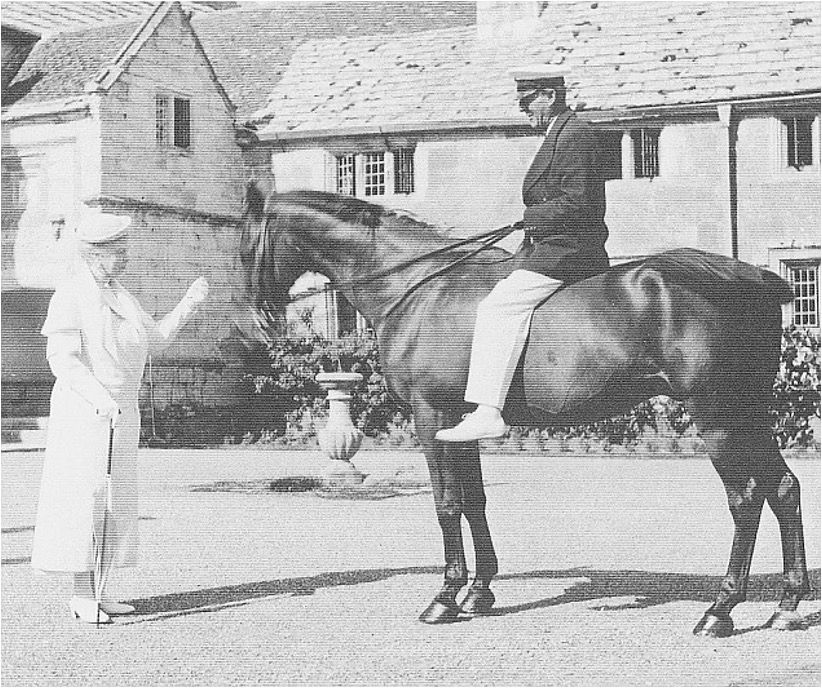
Figure 1: ‘The horse the Germans couldn’t kill’: Queen Mary with Warrior and Jack Seely, 1934. The Queen is presenting Warrior with a medal for his bravery during the Great War.[14]
Eric Baratay rewrites Warrior’s biography by reconstructing Seely’s narrative from within, without emptying it of its content.[15] Baratay’s principal criticism of the field of animal biography is that the dominance of human narratives pushes the animal’s lived experience into the background and obscures its visibility as a subject. For this reason, he reconstructs Warrior’s story not only through Seely’s memoirs, but also through a range of archival documents, military records, other testimonies, and, in particular, the body of knowledge provided by equine ethology. The aim is to shift the direction of the narrative from “Me and Warrior” to “Warrior and Them.”[16]
One of the most striking aspects of this intervention is the deliberate rendering of silences within the narrative visible. At the beginning of the biography, Baratay provides the reader with methodological guidelines. Four short dashes indicate moments of calm in Warrior’s life and function as markers suggesting the slowing down of time. In this way, Baratay focuses on and gives meaning to moments that are not directly narrated, are passed over quickly, or are entirely ignored in Seely’s text: Warrior’s separation from his mother, the physical and emotional burden of relocation, the bodily effects of being sent to the front, injuries, reactions of fear, loss of appetite, exhaustion, and social relationships. Baratay does not position these moments as gaps to be approached cautiously and passed over, as is often the case in traditional biography. On the contrary, he constructs them as the spaces that bear the most intense traces of the animal’s lived experience.
Through Baratay’s intervention, Warrior’s life unfolds from birth onward through an animal-centered perspective. Born on the Isle of Wight in the spring of 1908, Warrior’s first world was shaped around the strong bond he formed with his mother. Drawing on equine ethology, Baratay emphasizes that the bond between mare and foal is not merely a relationship of care; it is a structure that plays a decisive role in emotional regulation, security, spatial learning, and stress tolerance.[17] Warrior’s unusually strong attachment to his mother is a critical factor in understanding the impact of the separations he would later experience. Warrior’s castration is likewise approached from this perspective; the effects of the operation on the animal’s body and behavioral balance are evaluated in light of the veterinary practices and limited conditions of the period.[18]
A new chapter in Warrior’s life began when he was sent for training in 1914 and subsequently transported to the front. Baratay approaches this process not through the anonymous language of military logistics, but once again through the traces it left on the animal’s body: the jolts experienced during transport, the stress of being confined with unfamiliar horses, constantly changing environments, loud noises, vibrations, and flashes of light. Whereas Seely glorifies Warrior’s behavior at the front as “composure” and “fearlessness,” Baratay seeks to interpret these responses through the lens of ethology. He also treats Warrior’s social relationships as an integral part of the biography. His bond with his groom, Thompson, the friendships he developed with other horses such as Akbar and Patrick, and his rapport with Major Brooke all demonstrate that the animal’s world was not merely a backdrop to human narratives, but one that generated its own forms of sociality. These relationships can be read as the animal’s strategies for survival in the face of the ruptures produced by war.[19]
As the biography progresses, Warrior’s body gradually begins to bear the burden of war. Loss of appetite, intestinal pain, muscle cramps, exhaustion, lameness, and injuries; even the smallest details of Warrior’s experiences form the backbone of the biography in Baratay’s account. At the end of the biography, Warrior’s fate reveals a contradiction that prevents the possibility of truly “seeing” the animal by heroizing it and placing it within an anthropocentric framework. Having survived the most devastating phases of the war and become an almost mythical symbol over the years, Warrior was driven to starvation by food shortages and euthanized in 1941.[20]
From Warrior to Polat: Narrowings and Expansions
The biography written by Baratay is both a methodological critique and a comprehensive counter-narrative that makes Warrior’s life, labour, fears, and relationships visible. By reading Baratay, the reader witnesses not only how the biographical subject lived, but also the biographer’s intentions, ethical position, and the process through which a “traditional” biography is transformed into a “true” biography. The reader becomes involved in the text, particularly through the spaces that Baratay deliberately opens. Yet Baratay’s writing strategy, which stands in sharp contrast to traditional conventions, also comes with a certain methodological cost. To fully establish the animal as a subject, Baratay pushes scenes in which the animal is not at the center beyond the boundaries of the biography. This deliberate narrowing intensifies the animal’s experience; however, it may also limit the circulation of the political, cultural, and social texture of the period within the biography. As the animal’s lived experience becomes clearer, the historical context in which that experience is embedded recedes into a more indistinct background. Thus, one of the central tensions of animal biography becomes visible; the subjectification of the animal and the depth of context may not always be sustained to the same degree.[21]
This tension also overlaps with theoretical debates surrounding animal biography.[22] While animal biography aims to honor the individuality of the animal, it inevitably relies on processes of representation, selection, arrangement, and even exclusion; this renders biography a constitutive practice from beginning to end. Baratay’s biography of Warrior constructs the animal’s subjective world with remarkable clarity; yet it is precisely this intensification that compresses the biography into a narrow background. The question that emerges at this point is this: While placing the animal’s experience at its center, how can animal biography establish a balance with the texture of the historical period in which that experience unfolds?
We may seek an answer to this question by turning to Asu Aksoy’s Polat: A Horse, a Neighbor, and a Friend.[23]Without excluding the animal’s subjective experience, Aksoy’s biographical approach incorporates the historical, political, and social texture of the period as a constitutive element of the narrative. Polat was born on Heybeliada, one of the Princes’ Islands off the coast of Istanbul, in the autumn of 2019. Only a few months later, the outbreak of glanders on the neighboring island of Büyükada in December 2019 marked a decisive rupture in his life. Under the pretext of controlling the epidemic, all horses on the Princes’ Islands, an archipelago in the Marmara Sea, were placed under quarantine, and their stables were put under police supervision. Owners were denied access to their horses, and hundreds of horses died due to poor shelter conditions, inadequate nutrition, and lack of treatment. This veterinary crisis also made increasingly visible the structural collapse of the fayton (horse-drawn carriage) system, which had long been ignored.
Polat survives this first catastrophe. He does not contract glanders, nor is he among the hundreds of horses removed from the Islands during the first wave of evacuations, thanks to his owners’ refusal to sell him.[24] Yet this “survival” does not mean relative safety. From 2020 onward, the complete abolition of fayton transportation was presented as a political response to demands long voiced by animal rights advocates. Public discourse became dominated by a narrative of “saving the horses”; vigils held in Saraçhane, a central district of Istanbul near the municipal headquarters, the slogan “Freedom for the Horses,” and media campaigns transformed the process into a story of liberation. Yet, as Aksoy demonstrates, this decision initiated another process of displacement rather than genuine liberation for the horses. Hundreds of horses were loaded onto trucks and ferries and removed from the Islands; some died during transport, while others lost their lives shortly thereafter due to neglect and disease in the places to which they were sent. Thus, while the discourse of animal rights functioned as a veil that eased the public conscience, the horses were driven into a new sphere of uncertainty.[25]

Figure 2. A scene from the “Do Not Demolish the Stable” protest. Polat is visible in the background on the far left.[26]
Polat survives this second wave as well. Between 2020 and 2023, he remains on Heybeliada; he grows up alongside the island’s children, wanders through gardens, and becomes part of the everyday lives of his neighbors. Aksoy’s testimonies show that Polat was perceived on the island not merely as an “animal,” but as a neighbor and a friend.[27] Yet this relative calm comes to an end in the autumn of 2023 with a new municipal intervention. Claiming they were “roaming freely,” Polat and several other horses were removed from Heybeliada and transferred to the İSPARK[28]stable on Büyükada.[29] This forced relocation constitutes the third major rupture in Polat’s life. Only seven days later, Polat died at the Cerrahpaşa Faculty of Veterinary Medicine Animal Hospital. The official report records the cause of death as an intestinal blockage caused by a foreign object that had entered his digestive system; however, the injuries observed on Polat’s body, together with witnesses’ accounts of pain and neglect, point to a broader structural violence behind this technical explanation.[30]
The biography of Polat written by Asu Aksoy does not incorporate ethological approaches to the same extent as Baratay’s methodology, yet it intersects with the animal-centered sensibility that Baratay develops in Warrior. At the same time, it does not separate the animal’s lived experience from the political and institutional context of its time.[31] Polat’s body, fears, relationships, and death are read together with the governing practices of the municipality and state authorities, the discourses of the animal rights movement, the reactions of local residents, and the accumulated burdens of a fayton system that had been left unresolved for many years. His story makes visible how animals are governed in Turkey, how the discourse of animal rights is circulated, and how public decisions produce consequences on animal bodies. Polat is both a subject to be written about, known, and remembered, and a living witness to an urban policy, an ethical debate, and a crisis of governance. In this way, Aksoy demonstrates how animal biography can serve as a powerful tool for thinking about an era through the life of an animal.
Conclusion
The horse biographies examined in this study demonstrate that animal biography cannot be reduced to a single method; rather, each approach makes the subjectification of the animal possible in different ways and to different degrees. Aksoy’s biography of Polat reveals how the animal body intersects with political and administrative processes by situating the animal’s lived experience within, rather than apart from, its historical context. Baratay’s “new animal biography” approach, which places at its centre the questions of what the animal did, what it experienced, and how it related to the world, transforms not only the limits of subjectification but also the position of the historian. The historian is no longer situated alongside the human, but alongside the animal. This positioning is inevitably partial, speculative, and human; yet this limitation does not weaken the scientific value of animal biography. Rather, it constitutes its ethical and critical strength.
In conclusion, animal biographies open up a distinctive space for thinking that transforms the conventional boundaries of writing. By unsettling the assumption that an anthropocentric understanding of history is natural, inevitable, and universal, they reframe, on a more radical level, the question of who can be conceived as a subject of history. In doing so, the issue becomes not simply one of “including” animals in history, but of questioning what history is, how it is constructed, and upon which assumptions it is built.
[1] Cansu Asarkaya, Istanbul Bilgi University, cansu.asarkaya@hotmail.com.
[2] David Gary Shaw, “The Torturer’s Horse: Agency and Animals in History”, History and Theory 52 (December 2013): 150.
[3] Elaine Walker, Horse (London: Reaktion Books, 2012), 133–134.
[4] Peter Atkins, “The Urban Blood and Guts Economy”, in Animal Cities: Beastly Urban Histories, ed. Peter Atkins (London: Routledge, 2012), 78–79.
[5] Throughout this study, the term “animal” will be used in place of the concept of “non-human animal” in order to ensure the readability of the text and maintain conceptual consistency.
[6] Harriet Ritvo, “On the Animal Turn,” Daedalus 136, no. 4 (2007): 119.
[7] Deniz Dölek-Sever, “Osmanlı ve Türkiye Geçmişine Hayvan Tarihi Perspektifinden Bakmak”, Reflektif 5, no. 2 (2024): 243.
[8] Michael Rustin, “Reflections on the Biographical Turn in Social Science”, in The Turn to Biographical Methods in Social Science: Comparative Issues and Examples, ed. Prue Chamberlayne, Joanna Bornat and Tom Wengraf (London: Routledge, 2000), 46-48.
[9] Rustin, “Reflections on the Biographical Turn”, 45.
[10] Helmut Krebber and Brett Mizelle Roscher, “Introduction: Biographies of Animals”, in Biographies of Animals: Writing Animal Lives, ed. Helmut Krebber and Brett Mizelle Roscher (Bielefeld: Transcript Verlag, 2020), 2.
[12] Jack Seely, Warrior: The Amazing Story of a Real War Horse (London: Racing Post Books, 2011).
[13] Baratay, Animal Biographies, 35
[14] https://www.dailymail.co.uk/news/article-2740734/Warrior-First-World-War-horse-Germans-couldn-t-kill-posthumously-awarded-medal-animal-gallantry.html
[15] Baratay, Animal Biographies, 37-51
[16] Baratay, Animal Biographies, 36
[17] Baratay, Animal Biographies, 38
[18] Baratay, Animal Biographies, 39-40
[19] Baratay, Animal Biographies, 41-47
[20] Baratay, Animal Biographies, 46-51
[21] My argument is not that an animal’s biographical narrative must necessarily be accompanied by historical and cultural context. Rather, my intention is to open a space for thinking about the scope, reach, and methods of animal biographies.
[22] Krebber and Roscher, drawing on Pierre Bourdieu’s well-known discussion of the “biographical illusion,” argue that the nature of biography remains unresolved and still requires critical reflection. They regard this situation as both an invitation and a warning concerning the inclusion of animals within biographical frameworks. In doing so, they discuss the questions and tensions inherent in the effort to position animals as biographical subjects. André Krebber and Mieke Roscher, “Introduction: Biographies, Animals and Individuality,” in Animal Biography: Re-framing Animal Lives, eds. André Krebber and Mieke Roscher (Cham: Springer, 2018), 2–3, 8–9.
[23] Asu Aksoy, “Polat: Bir At, Komşu ve Bir Arkadaş,” Reflektif 5, no. 2 (2024): 415–434, https://doi.org/10.47613/reflektif.2024.169.
[24] Aksoy, “Polat,” 418.
[25] Aksoy, “Polat,” 418-420.
[26] Aksoy, “Polat,” 424.
[27] Aksoy, “Polat,” 422-426.
[28] İSPARK is a subsidiary company of the Istanbul Metropolitan Municipality that operates open-air, multi-storey, and on-street parking facilities throughout the city.
[29] Aksoy, “Polat,” 428.
[30] Aksoy, “Polat,” 429.
[31] Of course, it is also necessary to consider the archival advantages that stem from the historical proximity of the period in which Polat lived. Once again, I would like to emphasize that my intention is not to confine Baratay’s methods to a reductive or essentialist framework. Rather, it is to bring different modes of writing animal biography into a space for reflection on the subject of the biography, its author, its reader, and its effects.
Asarkaya, Cansu. “Animal Biographies: Boundaries, Possibilities, and Potentials.” Unpublished working paper, 2026. Available through the Hayvanât website: hayvanat.bilgi.org.tr.